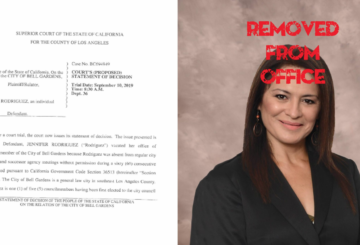
Isabel Guillen was elected to represent Bell Gardens — one of Southern California’s most
heavily immigrant communities. But her 2025 financial disclosure reveals she has been
collecting a six-figure salary as a senior paralegal at an immigration law firm now under
federal investigation for allegedly draining the life savings of the very people she was sworn
to protect.
Isabel Guillen sits on the Bell Gardens City Council. She was elected, at least in part, by and for
a community that is overwhelmingly Latino and immigrant. That makes her day job all the more
difficult to reconcile.
According to her 2025 California Form 700 financial disclosure, Guillen has been employed as a
paralegal at Alexandra Lozano Immigration Law PLLC, earning a gross income of
$100,000. Guillen_Isabel_2025_City of Bell Gardens_CityTown Council Member_Annual
The firm is now the subject of a federal investigation and a widening class action
lawsuit, with former clients alleging they were billed tens of thousands of dollars with nothing to
show for it — left stranded in immigration limbo while the firm’s principal traveled the country
on a pink private jet.
The question being asked by ethics observers and community advocates is a pointed one: how
can a public official who profits handsomely from a firm accused of exploiting immigrants claim
to be a genuine advocate for that same community?
More Than Just an Employee — A Senior Insider at the
Point of Entry
Guillen’s role at the firm is not peripheral. As a paralegal earning $100,000, she occupies a
senior position that goes well beyond administrative tasks. In immigration law firms like
Lozano’s, paralegals — particularly those at her compensation level — are typically responsible
for client intake, initial case assessments, gathering documentation, and completing the pre-
attorney groundwork that shapes every case from the moment a client walks through the door.
That means Guillen was, in all likelihood, one of the first faces a frightened immigrant family
encountered when seeking help. She was part of the process that signed clients up, collected their
information, assessed their eligibility, and set the table for the legal work — or alleged lack
thereof — that followed.
That is not a bystander role. That is a central one.
If the firm’s business model was, as federal investigators and class-action attorneys allege, to
collect large fees from desperate clients while delivering little to no meaningful legal results,
then the intake process — the pipeline Guillen is believed to have been part of managing — was
where that cycle began.
The Community She Serves vs. The Firm She Was Paid By
Bell Gardens is not a wealthy city. It is a working-class community where immigrants make up a
significant share of the population — many of them navigating the American legal system with
limited English, limited resources, and an overwhelming need to trust whoever offers to help
them.
Alexandra Lozano Immigration Law PLLC marketed itself aggressively to exactly that
demographic. The firm projected an image of success and results, while former clients allege
they were charged tens of thousands of dollars and left with nothing resolved — their cases
stalled, their savings gone, their futures still uncertain.
Guillen was elected to advocate for those people. Instead, she was on the payroll of a firm
accused of preying on them.
The compensation alone raises eyebrows. A paralegal salary exceeding $100,000 is
exceptionally high by any standard — and suggests that Guillen was not a low-level file clerk.
She was, by the evidence of her own disclosure, a valued and well-compensated insider at an
operation that ethics observers say should have never intersected with her public role in the first
place.
A Lifestyle Built on Inequality
The broader picture of Alexandra Lozano Immigration Law PLLC is one of staggering
contradictions. Investigative reporting has detailed how the firm’s principal lived extravagantly
— multi-million dollar real estate holdings, a signature pink private jet — while clients describe
being trapped in permanent legal uncertainty. https://www.youtube.com/watch?v=v6SwIlCVsXE
Guillen’s six-figure salary was part of that financial ecosystem. While immigrant families
scraped together every dollar they had to pay the firm’s fees, Guillen was earning a premium
income from the same operation. She then attended legislative mixers and city council dinners,
receiving gifts from industry groups like the League of California Cities and Communities for
California Cardrooms, networking in political circles while her employer allegedly left its clients
without legal recourse.
Both gifts — an $80 dinner and a $70 mixer — fall within California’s legal limits. But the
symbolism is hard to ignore: a public official living a life of professional access and comfort,
underwritten in part by an employer accused of exploiting the most vulnerable members of her
own constituency.
Federal Heat and a Collapsing Firm
The legal situation surrounding the Lozano firm is deteriorating rapidly. Federal investigators are
actively examining the firm’s operations following the high-profile resignation of its lead
attorney — a move that signals serious internal breakdown. Simultaneously, a new class action
lawsuit has been filed and may expand to encompass clients across the country, seeking
restitution for thousands who allege they were defrauded.
The civil and criminal tracks serve different purposes: federal investigators are examining
potential regulatory and criminal violations, while the class action is about financial
accountability to the clients who were allegedly wronged. Together, they represent a full-scale
reckoning. https://www.king5.com/article/news/community/facing-race/washington-immigration/federal-investigators-examining-former-tukwila-immigration-lawyer-alexandra-lozano-washington/281-a4ed0237-797e-4b92-b4e5-e07575864669
For Guillen, the collapse of her employer’s reputation is not just a professional inconvenience —
it is a mirror. The longer she remained embedded in the firm’s operations, drawing a senior salary
while the alleged harm to clients compounded, the harder it becomes to argue that her values and
the interests of Bell Gardens’s; immigrant community were ever truly aligned.
A Values Problem, Not Just a Paperwork Problem
Supporters of Guillen may point out that disclosing the employment on a Form 700 means she
followed the rules. And technically, that is true. But the purpose of the Form 700 is not merely to
generate paper trails — it is to force public officials to reckon with conflicts between their
private interests and their public responsibilities.
The filing does not absolve Guillen of a deeper accountability question. It raises it.
A city council member who serves an immigrant community, who draws a senior-level income
from a firm that allegedly victimized that same community, and who was directly involved in the
intake process that funneled those clients into the firm’s pipeline — that person has serious
questions to answer. Not just legal ones. Moral ones.
Who does Isabel Guillen work for? The constituents of Bell Gardens — or the firm that paid her
$100,000 to help bring them in the door?
This article is based on publicly available financial disclosure records and previously reported
investigative findings.